
Lawns we have turned around
Thin, tired lawns can come back with the right seed, soil work and timing. These are real properties we care for, and every photo on this page is our own.

Before and after
Each pair shows the same lawn.
 Before
 After
 Before
 After
 Before
 After
 Before
 After
 Before
 After
 Before
 After
What turns a lawn around
There is no single product that does it. It is a few things done in the right order, at the right time.
- The right seed for the site.Bluegrass for irrigated sun, tall fescue for dry sun, and fine fescue only in shade. Seed that does not suit the spot will thin out again.
- Soil work.We look at the soil and the roots before we treat. Lime, micronutrients and a wetting agent go down where the lawn needs them.
- Timing.We feed when the grass is growing. The soil and the weather set the schedule, not a date on the calendar.
- Aeration and overseeding.Aeration pulls small plugs of soil so air, water and seed can get down to the roots. We do it in late summer, when new grass establishes best.


Where lawns start
Not every lawn starts out green. Brown, thin or patchy is a starting point, and we would rather show you that than only the finished photos.
The Road to 100
In 2027 we have set ourselves a public goal: turn around 100 lawns, all for brand-new customers.
If your lawn is thin, patchy or worn out, it can be one of the hundred. In your first year we build a plan around what your property needs, with one goal: a Royle quality lawn in the first year. Some lawns take longer, and we will tell you if yours is one of them.
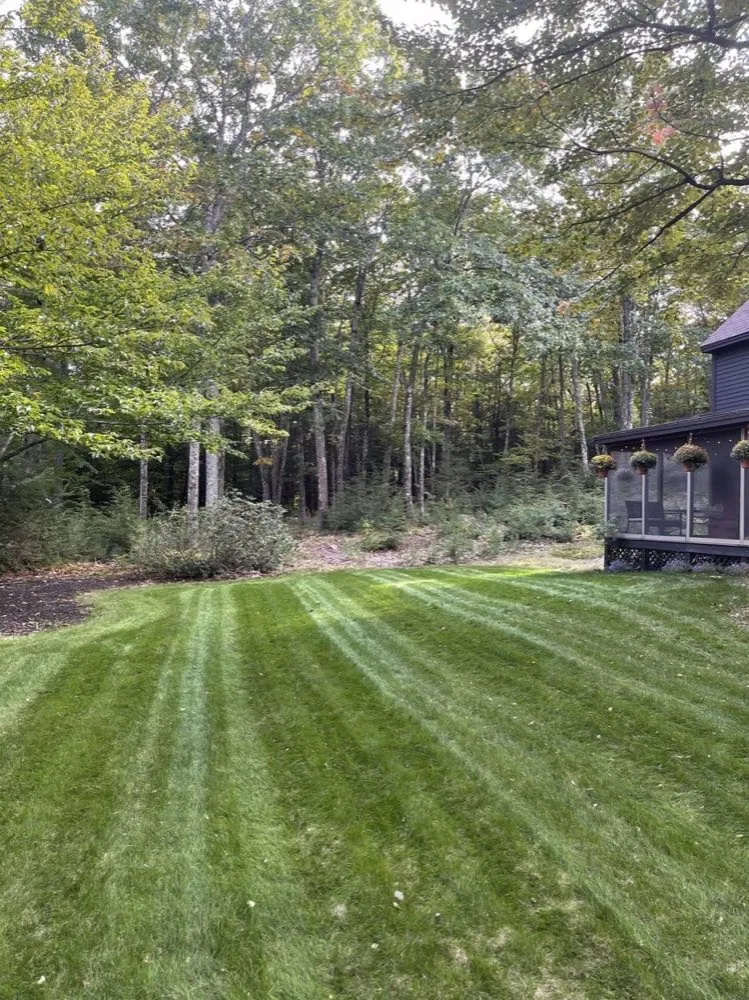
Lawns we look after now
A few of the lawns on our route.



Questions about turning a lawn around
What is the Road to 100?
It is our public goal for 2027: turn around 100 lawns, all for brand-new customers.
If your lawn is thin, patchy or worn out, it can be one of the hundred. In your first year we build a plan around what your property needs, aiming for a Royle quality lawn by the end of the season. We go over that plan and its price with you before we start.
How long does it take to turn a lawn around?
It depends on where the lawn starts and what it needs.
The pairs on this page show the range. A sunny Acton lawn we reseeded with tall fescue was green five weeks later. A New Durham lawn was thick by the next summer. The Sanford lawn and the sandy Brookfield cemetery grounds took about 16 months. New seed needs the right time of year and steady water to take hold. We will tell you honestly what to expect for your lawn.
What usually causes a thin or patchy lawn?
Most often it is a few problems together, not just one.
On the lawns on this page we found grubs, chinch bugs, drought and broken or switched-off irrigation, poor sandy soil, crabgrass, and grass seed that did not suit the spot. That is why we find the cause before we treat. The right fix for the wrong problem does little for a lawn.
Are these photos of real lawns?
Yes. Every photo on this page is our own, taken at real properties we care for.
Each pair shows the same lawn. We include the brown and bare starting points on purpose, so you can see where a lawn began.
Which program is right for my lawn?
If your lawn is already thick and healthy, the 4-Step is built to keep it that way. Most customers choose the 6-Step, our most popular program, because it adds lime, an early summer feeding and disease protection. If your lawn is thin, patchy or worn out, or you simply want it at its best, The Royle Treatment adds monthly visits and seeding every year.
Not sure? Call or text 603-882-6522 and we will look at the lawn and tell you honestly what it needs. See all three on our lawn care page.
When do you aerate and overseed?
In late summer, when the soil is still warm and the nights are cooler. That is when new grass grows in best in New Hampshire and Maine.
If your lawn does not have irrigation, it needs watering for about three weeks in September afterward so the new seed can take hold. Aeration and overseeding are included in The Royle Treatment and can be added to the 4-Step or 6-Step.
What kind of grass seed do you use?
We match the seed to your yard. Kentucky bluegrass goes on sunny lawns with irrigation, tall fescue on sunny lawns without it, and fine fescue only in shade.
The right seed in the right spot lasts much longer than a one-size-fits-all mix. Seed that does not suit the spot will thin out again.
How much does lawn care cost?
It depends mostly on the size of your lawn. For a lawn of about 10,000 square feet, a season of the 4-Step program runs about $410 to $470, the 6-Step about $620 to $700, and The Royle Treatment about $1,370 to $1,590, with aeration and overseeding included.
You can see the range for your own lawn size in about a minute with our price tool. We measure your lawn and confirm the exact price with you before any application.
Get a price for your property
Tell us where the property is. Or call or text 603-882-6522.
★★★★★ "Tylar and his staff did a fantastic job saving my lawn this year." Todd Jakubec, Google review
Let's take a look at your yard.
See your price range in a minute, or call or text and we will walk the property with you.