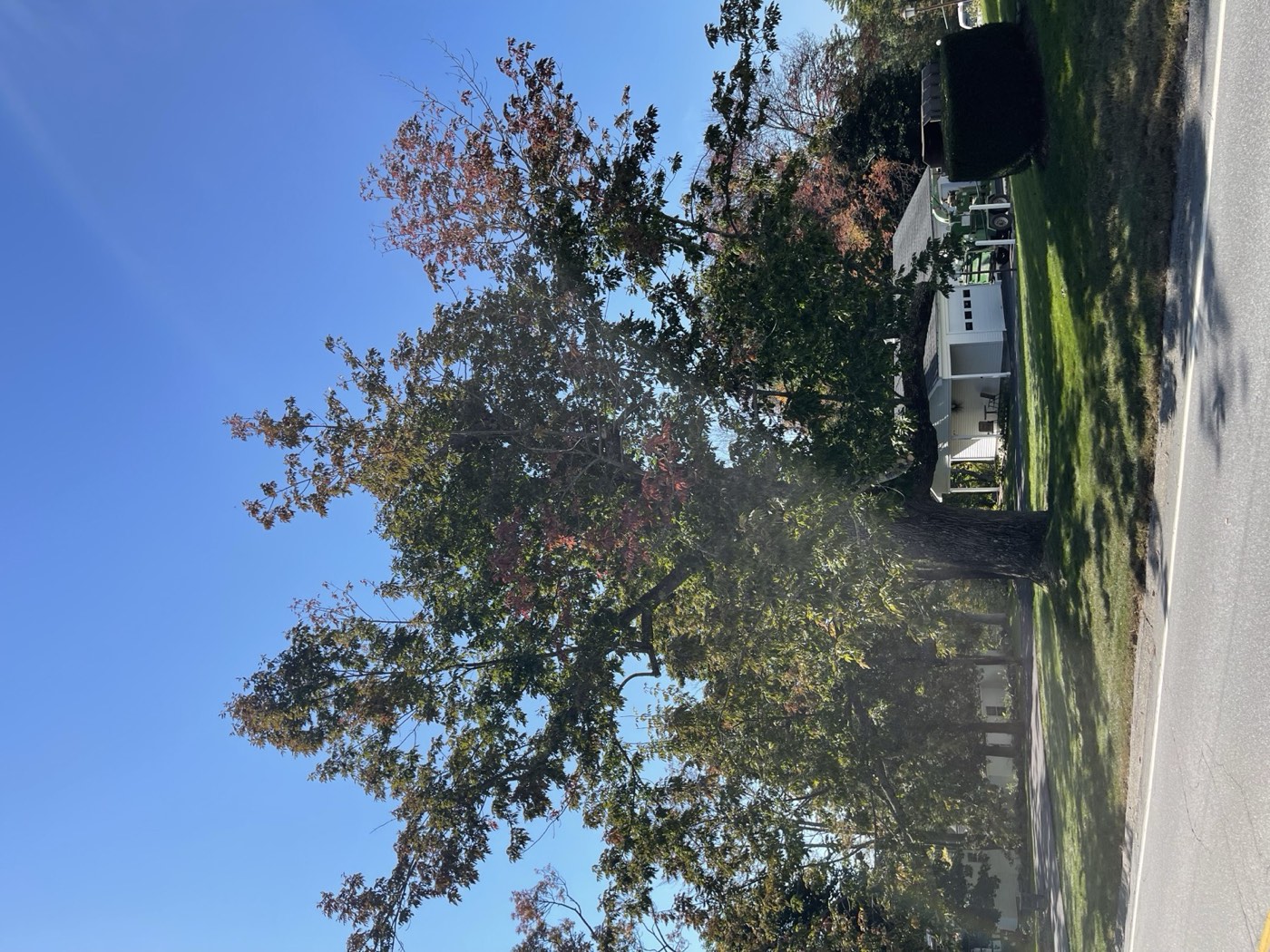
If you own property in Carroll County, you have ash trees. They're common in our mixed hardwood forests, along roadsides, in wetlands, and on residential properties. And if you have ash trees, you need to know that emerald ash borer is no longer a threat on the horizon. It's already here, established throughout the region, and actively killing ash trees.
This isn't a future problem. This is happening now. Some ash trees in Ossipee, Tuftonboro, and the surrounding towns are already dead. Others show early symptoms. And some look completely healthy while harboring larvae under their bark. The difference between a tree you can save and one that's past the point of recovery can be just a few months.
What You're Actually Looking At
Emerald ash borer is a small, metallic green beetle about half an inch long. It came from Asia, arrived in North America in 2002, and has since killed hundreds of millions of ash trees across the continent. It has no natural predators in North America, and our native ash species have virtually no resistance to it.
The beetle's larva is what does the damage. After a female lays eggs in the bark crevices of an ash tree, the tiny larvae hatch and immediately burrow into the bark, where they feed on the cambium and phloem layers. The cambium is what transports water and nutrients from the roots to the crown. When larvae tunnel through it, they sever these vital connections. The tree starves.
The feeding galleries they create are distinctive S-shaped tunnels in the wood. A single tree can contain hundreds of larvae feeding simultaneously, creating a lattice of damage that eventually girdles the vascular system beyond recovery.
How to Identify an Ash Tree
Before you can know if your tree is at risk, you need to know if you have an ash tree. Ash trees have several diagnostic features that make identification straightforward year-round.
In the growing season, ash trees have compound leaves. Unlike simple leaves, compound leaves are made up of 5 to 11 leaflets arranged opposite each other along a central stem. This is one of the quickest ways to identify an ash. Also look at the branching pattern. Ash branches grow opposite each other, not alternating like many other trees. In winter, when the leaves are gone, look at the branches themselves. Ash trees have distinctive D-shaped leaf scars left where the compound leaves fell. In spring, before the leaves fully unfold, you might see horseshoe-shaped branch scars on the trunk where limbs fell or were pruned.
The bark pattern is also diagnostic. Many ash trees, especially as they mature, develop a diamond-shaped pattern of ridges and furrows that's quite distinctive once you know what to look for.
Signs of Emerald Ash Borer Infestation
Early detection matters enormously because it determines whether treatment can be effective. Here's what to look for.
The most visible early sign is canopy thinning starting from the top of the tree and progressing downward. The tree's crown becomes sparse, starting at the outermost branches. This happens because the larval galleries are disrupting nutrient and water transport, and the tree sheds branches as a stress response. A healthy ash in July should have full, dense foliage. A thinning crown is a warning sign.
Look for small, D-shaped exit holes in the bark. These are about the size of a match head, and they're where adult beetles emerged from the tree after completing their life cycle. If you see these, infestation is underway.
If the bark is loose or peeling, especially in vertical strips, peel it back carefully. You may see the S-shaped galleries underneath. This is diagnostic for EAB. In some cases, you'll also see woodpecker activity. Woodpeckers are attracted to the larvae and will flake bark away to access them, leaving the tree looking roughed up.
Watch for epicormic sprouting, which is a mass of small new shoots emerging from the trunk or main branches. This is the tree's last-ditch effort to save itself, pushing out new growth after realizing much of its crown is compromised.
In late stages, you may see vertical cracks or splits in the bark, especially along the trunk. These are stress cracks from the internal damage.
When Can You Still Save a Tree?
This is the hard part. If a tree shows more than about 50 percent canopy dieback, treatment is unlikely to produce meaningful results. At that point, the damage is too extensive and the tree's ability to compartmentalize the infection and generate new growth is compromised. You can treat it, but you're likely just delaying the inevitable.
If a tree still has a dense, healthy crown but shows early signs of infestation like a few D-shaped exit holes or early canopy thinning, treatment can work. The window for effective intervention is probably 6 to 18 months from when infestation first becomes visible, depending on the tree's vigor and the extent of internal damage.
This is why monitoring matters. If you have ash trees on your property and you're in Carroll County, you should be checking them for signs of EAB at least annually, ideally in late summer when the exit holes are most visible.
Treatment Options
The most effective treatment is trunk injection using systemic insecticides. The two most commonly used are emamectin benzoate and dinotefuran. These are injected directly into the tree's vascular system, where the active ingredient circulates with the tree's own transport systems and poisons the larvae feeding on the cambium.
Trunk injection is preferred because the insecticide is contained entirely within the tree. It doesn't move into soil, doesn't run off into stormwater, and doesn't harm soil organisms or beneficial insects. The tree absorbs and translocates the active ingredient, delivering it exactly where the larvae are feeding. Residual effectiveness typically lasts 2 to 3 years, after which a retreat may be necessary.
Soil application or basal drench using imidacloprid is another option, especially for properties not near water. The insecticide is taken up through the roots and circulates through the tree much like the injected approach. The trade-off is that some of the product remains in the soil, and for properties near lakes or with high water tables, this is less desirable than trunk injection.
Foliar spray is generally limited to small trees and is not a primary tool for emerald ash borer management on larger trees.
The Case for Removal
Not every ash tree is worth saving. A tree that's already 60 percent dead, standing directly over a building or power line, or showing such extensive damage that treatment costs more than removal often makes more economic and safety sense to remove and replace.
If removal is the path forward, do it before the tree becomes a hazard. A dead ash tree becomes brittle within a year or so, and branches begin to fail. Managing the removal on your timeline is always better than having a tree fail unexpectedly during a storm.
The Ecological Dimension
Ash trees are ecologically significant in this region. They anchor slopes, stabilize streambanks, provide food for wildlife, and shade cold-water tributaries. In wetland areas, ash trees help regulate water levels. Along the streams that feed Ossipee Lake, Province Lake, and Great East Lake, ash trees shade the water and help maintain the cool temperatures that native brook trout need.
The large-scale loss of ash trees from our landscape will have consequences for water quality, slope stability, and wildlife habitat. This is another reason why identifying and treating infested trees while they can still be saved matters.
Have Ash Trees on Your Property? Let's Take a Look.
We can assess your ash trees for signs of emerald ash borer, discuss treatment or removal options, and help you decide the best path forward.